

Seattle-area building permits — search any address
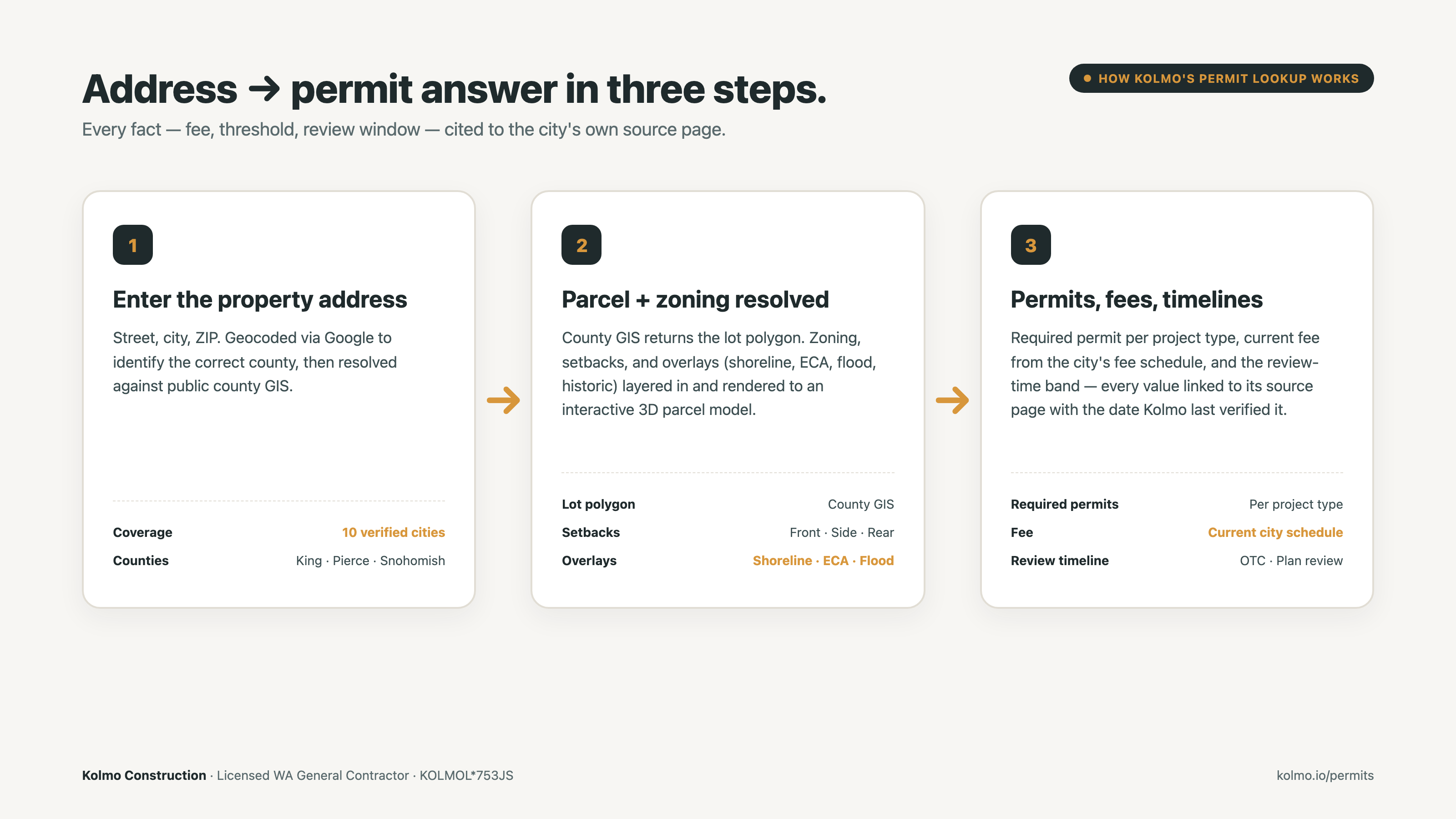
Enter your address. See your lot in 3D, your zoning, your setbacks, and what permits the project needs — with the city's own code quoted behind each answer.
Your lot in 3D
Interactive parcel model with setbacks, buildable envelope, the existing structure, and proposed massing — rendered on your real lot polygon from county GIS.
Cited to the source
Every threshold, fee, and requirement opens the verbatim quote from the city's own page with the URL and date we pulled it.
A one-page permit summary
For your lot and project: the city's rule with its source, the submittals the city asks for, the inspection sequence, and where to file. Print it or save the PDF.
Start with your project
See the permit requirement for your project in each of the 16 covered cities, with the fee and review timeline where the city publishes one.
Browse a city's rule index
Open a city to see every project type, the requirement that triggers a permit, the fee range, and review timeline — no address needed.
How Seattle-area building permits work
Reviewed by Frederic G. Atallah, Partner at Kolmo LLC (WA contractor license KOLMOL*753JS) · Last verified: — fees and timelines re-checked against each city's source pages. How we keep this current →
How much does a Seattle-area building permit cost?
Permit fees in the Seattle metro generally fall into two pieces: a base submittal fee and a plan-review/issuance fee tied to the project valuation. A small residential project — interior bathroom remodel, electrical service upgrade, window replacement — typically lands between $250 and $900 all-in. A whole-home remodel, addition, or ADU runs $2,500 to $9,000+ once valuation-driven fees and SDCI/department surcharges are layered in. Seattle's numbers are computed from the 2026 SDCI Fee Subtitle; for the other cities the estimate walks the standard valuation table most Washington cities adopt, and the city's own schedule is linked beside it — see the side-by-side per project type.
How long does a building permit take in the Seattle area?
Over-the-counter (OTC) permits — like-for-like window replacement, simple electrical or plumbing, water-heater swaps — issue in 0 to 5 business days across the verified cities. Standard residential plan review (bathroom, kitchen, basement finish) runs 4 to 10 weeks. Additions, ADUs, and projects touching the building envelope often hit 10 to 20 weeks once structural, energy, and (in some cases) shoreline or critical-area review are involved. Where a city publishes its own review-time target, the per-city page quotes it; where it does not, the page says so rather than guessing.
What projects need a permit — and what doesn't?
Across the covered cities, the projects that almost always require a permit are: ADUs and DADUs, additions, structural alterations, new decks over 30 inches off grade, fences above the city's height limit (6 ft in Kirkland, Renton and Shoreline, 7 ft in Redmond, Kent and Tacoma, 8 ft in Seattle and Bellevue), new electrical service, new gas piping, new plumbing rough-ins, full window replacement when the rough opening changes, re-roofs over a value threshold, and basement finishes that add habitable space. Projects that often do not need a permit: like-for-like paint, flooring, cabinetry, countertops, drywall repair, interior trim, and fences under the city's height limit. The compare tables above show the exact threshold for every city — because the "needs a permit?" answer changes at the threshold, not at the project type.
Do I need a contractor to pull the permit?
In Washington State, owner-occupants can pull their own residential building permit for their primary residence. The catch: the contractor doing the work has to be registered with L&I, and electrical and plumbing work generally requires a licensed specialty contractor for inspection sign-off — regardless of who pulled the permit. If you're hiring a general contractor, the GC typically pulls the permit on your behalf and is responsible for inspection coordination. For the covered cities, the permit packet we generate identifies which specialties your project will need.
Why this page exists
Most permit answers on the public web are stale — wrong fee, wrong threshold, wrong review window — because cities update their fee schedules and code references quarterly while general-information sites do not. Kolmo is a licensed Seattle-area general contractor. Each rule on our pages carries the date Kolmo last sourced it, and an automated scanner watches the source pages daily for changes. See how we keep this current →
Common questions
Which cities is the Kolmo permit lookup verified for?
16 cities: Seattle, Bellevue, Kirkland, Redmond, Sammamish, Issaquah, Renton, Kent, Federal Way, Mercer Island, Shoreline, Tacoma, Lakewood, Puyallup, Everett, Lynnwood. Depth varies by city and is published, not claimed: most carry the city's own code quoted verbatim for 15 to 19 of 21 project types; Everett and Lynnwood carry far fewer, and every answer that falls back to the Washington state code says so. Seattle permit fees are computed from the 2026 SDCI Fee Subtitle; other cities' fee estimates use the standard valuation table with the city's schedule linked. Outside these cities address lookup still works and shows the parcel and the state baseline.
Does the lookup cover unincorporated King, Pierce, or Snohomish County?
Address lookup works and parcels resolve to the county building department, but unincorporated coverage is currently baseline-only — Washington-state IRC, IBC, and WSEC plus state critical-area rules. Per-county fee and code deviations have not been verified to the same standard as the covered cities.
Will this replace calling the permit center?
For most homeowner projects — decks, kitchens, bathrooms, ADUs, fences, siding, windows, flooring, roofing, HVAC, electrical, plumbing — the answer quotes the city's own rule, and the one-page permit summary lists the submittals and where to file; the application itself is the city's form. For variances, conditional uses, or unusual scope, calling the city planner is still recommended.
Where does the address go after submission?
The address is geocoded via Google Maps to identify the correct county, then queried against public county GIS endpoints. Parcel data is cached for 30 days. The address is not contacted, sold, or shared with third parties.
Who built this — and why?
Built by Kolmo Construction, a licensed Seattle-area general contractor. The team works with permit code daily and built this to fix the public web's poor coverage of homeowner permit questions. The lookup is free; if a homeowner wants a contractor for the project, Kolmo is one option.
Stuck on a permit question?
Variances, unusual scope, an address that won't resolve, or just want a human to weigh in — call or email and we'll take a look.